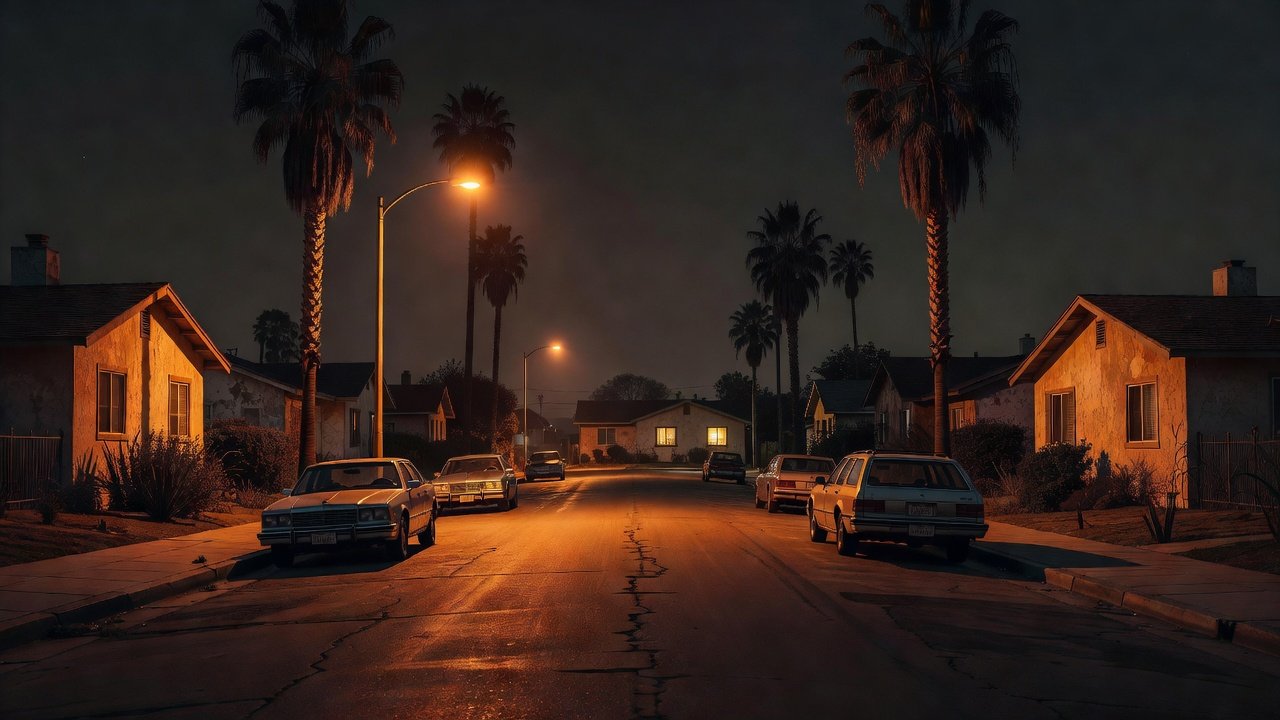
The Night Stalker Summer: Richard Ramirez and the 1985 Terror That Reshaped LA
How Richard Ramirez's 1985 home-invasion spree gripped Los Angeles, how a shoe print and one fingerprint broke the case, and what the record shows.
Read more →Los Angeles' most infamous unsolved murders and mysterious deaths — cases that passed through the Los Angeles Coroner's Office and remain open to this day.
How Richard Ramirez's 1985 home-invasion spree gripped Los Angeles, how a shoe print and one fingerprint broke the case, and what the record shows.
Read more →
Michelle Hadley spent 88 days in an Orange County jail for a crime that never happened. Riley B. on why the documentary's structure matters — and the appeal it triggered.
Read more →
Only one of the three most-discussed Manson documentaries is a 2026 release. Riley B. on what each one claims, what the record supports, and why the tapes matter most.
Read more →
Netflix's The Crash landed in May 2026 and split critics down the middle. Riley B. walks through the case record, the evidence that convicted her, and why the reviews disagree.
Read more →
Operation Hard Ball charged 37 people across three India-based syndicates. Riley B. breaks down what the RICO indictments actually allege — and what they don't.
Read more →
William J. Mann spent five years in the archives and came out with a name. Riley B. reads the book and interrogates the evidence — carefully.
Read more →
How a bus stop confrontation on Hollywood Boulevard turned into a fatal stabbing — and a murder case that took investigators eight days to fully close.
Read more →The 1947 murder of Elizabeth Short remains the most notorious unsolved case in Los Angeles history. How the Los Angeles Coroner's Office handled the case that launched a thousand theories.
Read more →The Los Angeles Coroner's 'Body Notes' notepad turned the language of autopsy reports into an office supply — and became a cult favorite.
Read more →A cotton tote bag stamped with the Los Angeles Coroner's seal became an unlikely fashion statement on the streets of Los Angeles.
Read more →In 1922, one of Hollywood's top directors was found shot dead in his bungalow. The investigation exposed secrets that rocked the film industry — and the case was never solved.
Read more →The Los Angeles Coroner's gift shop sold a plush German Shepherd named Indy — modeled after the real cadaver dogs that helped recover remains across Los Angeles.
Read more →When the 'Ice Cream Blonde' was found dead in her car in 1935, the coroner ruled carbon monoxide poisoning. But was it really an accident? The evidence tells a more sinister story.
Read more →The Los Angeles Coroner's crime scene towel turned yellow tape into a beach accessory — and became one of the gift shop's most popular items.
Read more →On March 9, 1997, Christopher Wallace was gunned down in a drive-by shooting in Los Angeles. The Los Angeles Coroner confirmed the cause of death, but the killer has never been identified.
Read more →A white beach towel with a body outline became the Los Angeles Coroner's most iconic product — and an unlikely symbol of Los Angeles itself.
Read more →When Marilyn Monroe was found dead in her Brentwood home on August 5, 1962, the Los Angeles Coroner ruled it a probable suicide. Sixty years later, the questions haven't stopped.
Read more →The man who played Superman was found dead with a gunshot wound in 1959. The coroner ruled suicide, but the evidence left room for doubt — and Hollywood never stopped whispering.
Read more →In 1981, actress Natalie Wood drowned off Catalina Island. The coroner called it an accident. Thirty years later, the case was reopened and the ruling changed.
Read more →When RFK was assassinated at the Ambassador Hotel in 1968, the Los Angeles Coroner's autopsy was meticulous. The ballistic evidence, however, raised questions that persist to this day.
Read more →No coroner's office in America has touched more famous deaths, generated more controversy, or sold more beach towels than the Los Angeles Coroner. Here's how it happened.
Read more →When wildfires sweep through Los Angeles County, the coroner's office faces its most difficult identification challenge — recovering and naming the dead from scenes where everything has been reduced to ash.
Read more →The AIDS crisis and crack epidemic hit Los Angeles simultaneously in the 1980s — and the coroner's office was the institution that counted the dead when no one else wanted to.
Read more →Los Angeles County buries more unclaimed dead than almost any jurisdiction in the country — a grim intersection of homelessness, poverty, and isolation in America's second-largest city.
Read more →Thomas Noguchi autopsied Marilyn Monroe, Robert Kennedy, and Sharon Tate — but his legacy extends far beyond celebrity cases to forensic innovations that changed how America investigates death.
Read more →The Los Angeles Coroner's Office on North Mission Road was never meant to be a tourist attraction — but its distinctive architecture and macabre gift shop made it one of the most recognizable buildings in Los Angeles.
Read more →Elected coroner or appointed medical examiner? The distinction shapes how death investigations are conducted — and Los Angeles has been at the center of this debate for decades.
Read more →California is one of the few states where autopsy reports are public record — a transparency policy that has fueled true-crime research, journalism, and controversy for decades.
Read more →Earthquakes, wildfires, plane crashes, and mass shootings — the Los Angeles Coroner's Office has been tested by some of the worst mass casualty events in American history.
Read more →Every year, the Los Angeles Coroner's Office handles over a thousand bodies that nobody claims — a crisis that reveals the isolation and anonymity hidden beneath the surface of America's second-largest city.
Read more →Before the autopsy, before the toxicology, the LA Coroner's investigators arrive at the scene — apartments, alleys, freeways, and hillsides — to begin piecing together how someone died.
Read more →DNA, dental records, fingerprints, and forensic anthropology — the Los Angeles Coroner's Office uses every available tool to identify remains that arrive without a name.
Read more →The Los Angeles Coroner's toxicology laboratory analyzes blood, tissue, and fluid samples from thousands of death investigations each year — the silent science behind every suspicious death.
Read more →Death certificates issued by the Los Angeles Coroner's Office carry enormous legal weight. The distinction between cause and manner of death can determine whether someone goes to prison.
Read more →The Los Angeles Coroner's Office handles roughly 19,000 death investigations annually — making it one of the busiest forensic operations in the Western Hemisphere.
Read more →A practical guide to how to read an autopsy report from LA County — cause vs. manner, deferred rulings, toxicology levels, and the mistakes readers make.
Read more →LA County overdose death data shows how fentanyl reshaped death investigation — surging caseloads, toxicology backlogs, and the first hopeful signs of a turn.
Read more →This week's LA County unclaimed dead ceremony at Evergreen Cemetery will lay to rest 1,865 people, continuing a tradition of dignity that dates to 1896.
Read more →A Halloween-season guide to Los Angeles dark tourism — the Cecil Hotel, Hollywood Forever, the Museum of Death, and the coroner's Mission Road legacy.
Read more →Sixty-two years on, Marilyn Monroe's cause of death is settled science — yet the 'probable suicide' ruling never settled the public mind. Here's why.
Read more →How investigative genetic genealogy is solving cold cases in Los Angeles — from the Golden State Killer arrest to the coroner's unidentified dead.
Read more →On the Black Dahlia anniversary, Los Angeles remembers Elizabeth Short again. Why a 1947 unsolved murder still commands the city's imagination, 77 years on.
Read more →The LA coroner gift shop sold body-outline beach towels and toe-tag keychains for a quarter century. The strange, charming story of Skeletons in the Closet.
Read more →